Cyberdroid Neural Engine mark
CYBERDROID NEURAL ENGINE

See the attack behind the alert.

Cyberdroid Neural Engine learns how every user, host, process, application, and relationship normally behaves — then catches the spikes, silences, drifts, new edges, and campaign patterns that rule-only stacks miss.

Request a Technical Demo Explore the Detection Engine
TEN YEARS OF DETECTION SCIENCE · ONE ENGINE
0+ ALGORITHMS & MODEL VARIANTS
0 DETECTION FAMILIES
0 PATENTED & PATENT-PENDING FAMILIES
0 EVIDENCE CONTRACT
THE PERCEPTION PIPELINE

One engine.
Many ways to catch change.

Time-series ML, peer-group analytics, deep-learning reconstruction, graph relationship models, threat intelligence, and deterministic detections — one evidence pipeline. Instead of asking analysts to trust a black-box alert, the engine shows the model, the baseline, the entity, the relationship, and the supporting evidence.

{{ s.n }} {{ s.name }}

{{ s.desc }}

THE EVIDENCE CONTRACT
What happened, to whom, why we believe it,
and what evidence supports it.
Every detection is normalized with algorithm · anomaly_score · confidence · reason · context · features — one contract across all 200+ instruments.
{{ r }}
THE MODULES

Behavior. Relationships. Stories.

NEURAL UEBA · MODULE 01

Baselines for everything that behaves.

Neural UEBA learns per-entity behavior across users, hosts, applications, processes, and hourly features — then watches it with multiple independent anomaly families instead of a single opaque score.

WHAT IT CATCHES — HOVER FOR THE EVIDENCE
EVIDENCE FIELD {{ chipField }}
WHERE YOU SEE IT {{ chipSurface }}
MODEL FAMILIES ON WATCH
{{ m }}
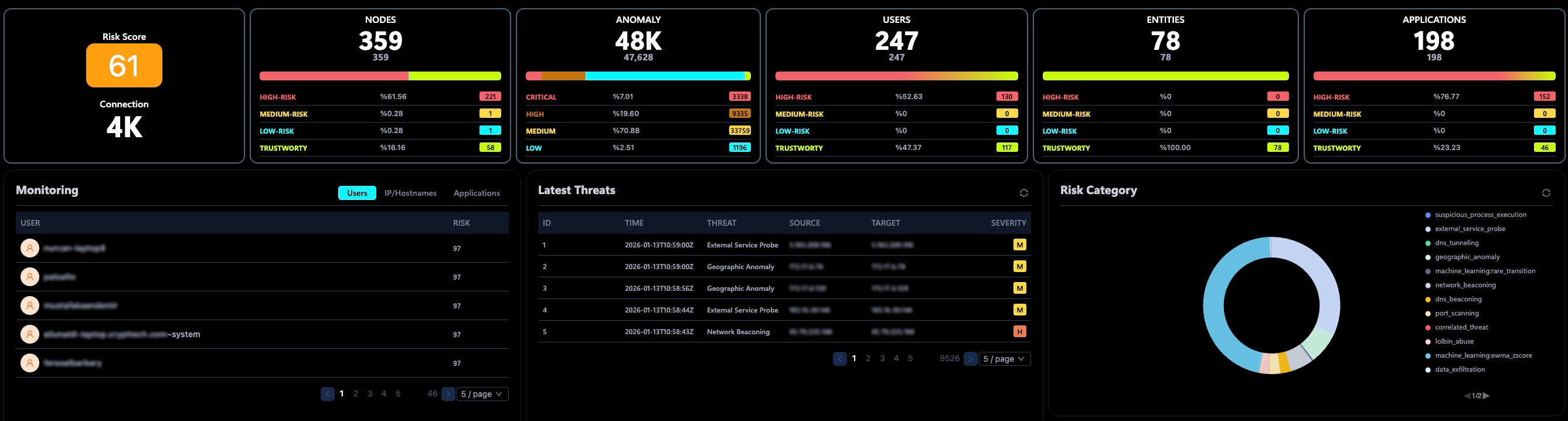
CNE-SHOT-UEBA-01
Neural UEBA entity risk overview
Entity risk overview — per-entity baselines, live risk distribution, latest threats, and risk categories on one surface.
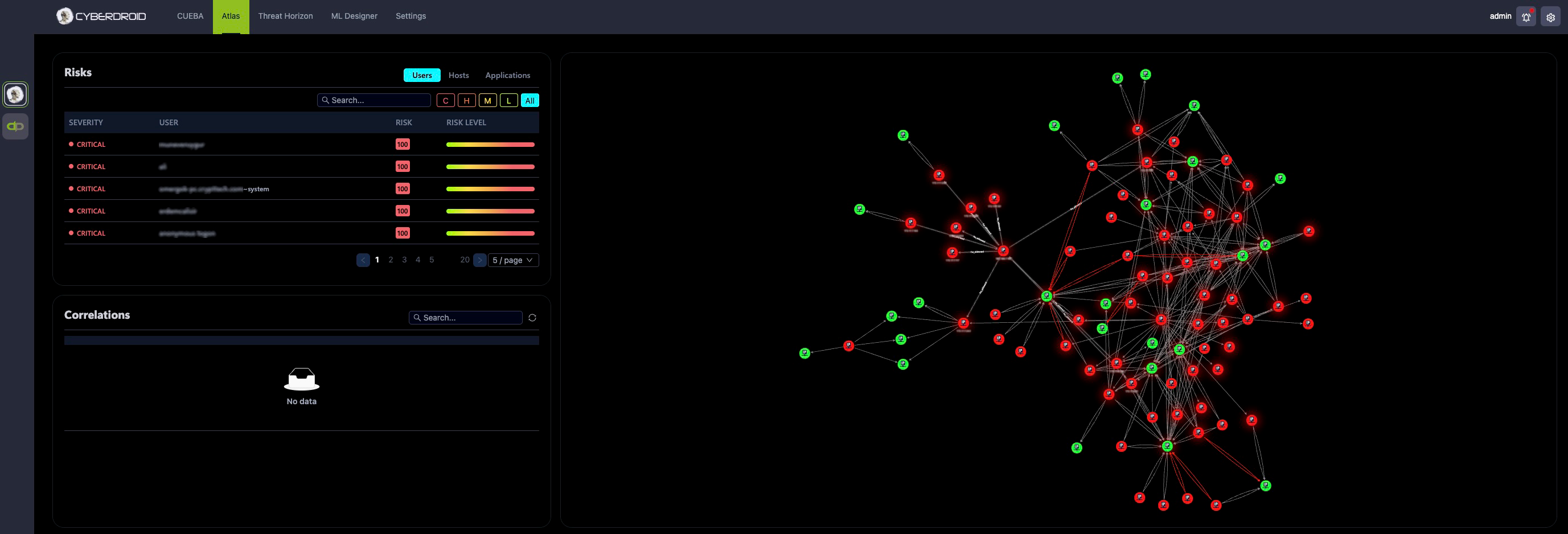
CNE-SHOT-ATLAS-01
Atlas entity risk graph
Tenant-wide risk neighborhoods — every entity resolved into one persistent graph.
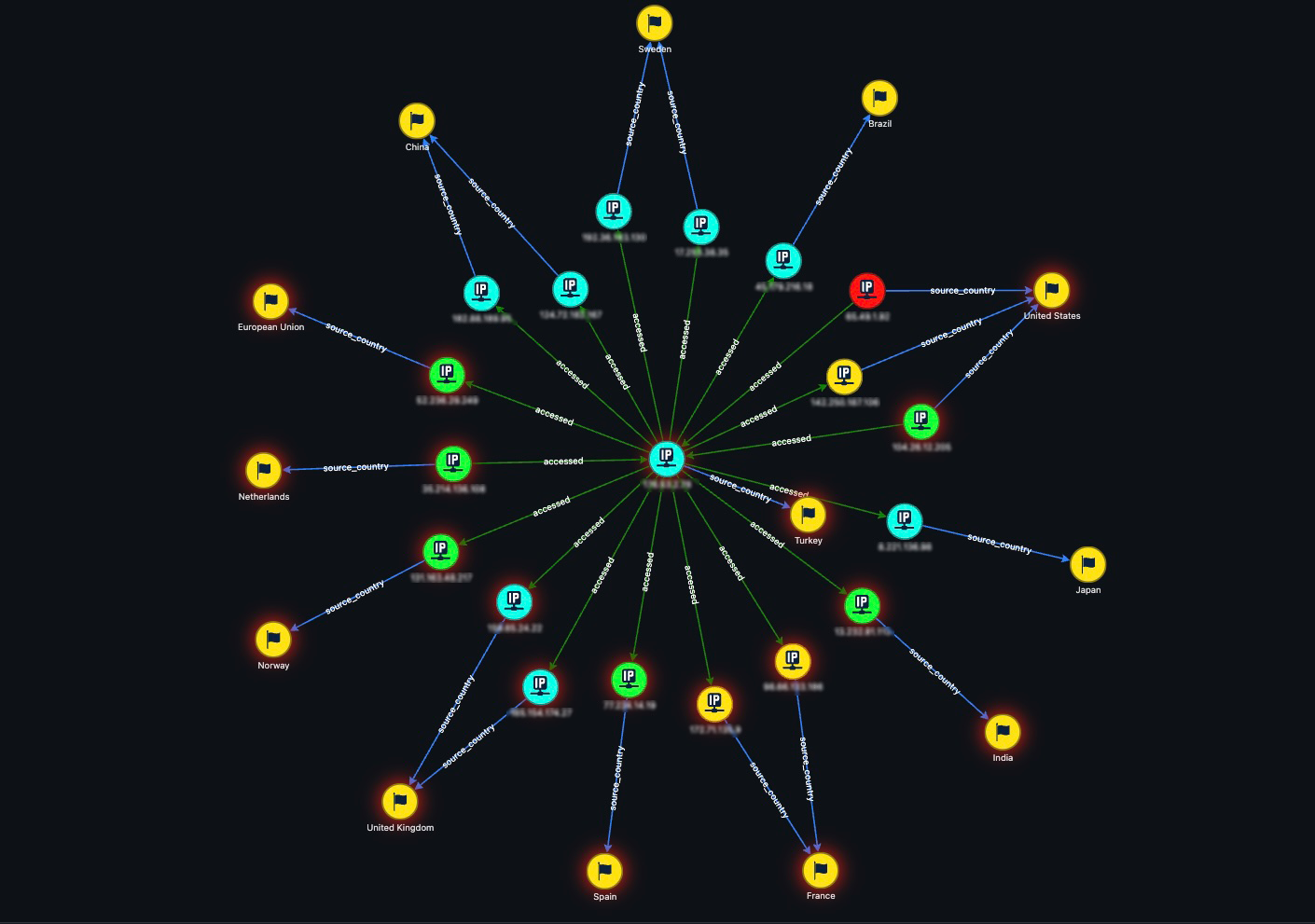
CNE-SHOT-ATLAS-02
Atlas ego view with source countries
Ego view — one host's access edges, resolved to source countries.
ATLAS GRAPH · MODULE 02

Lateral movement is a graph problem.

Atlas is the graph intelligence layer. It builds a persistent entity graph — hosts, users, processes, network endpoints, authentication activity, observed security events — and treats relationship change as detection signal, not decoration.

{{ cap.n }} {{ cap.name }} — {{ cap.desc }}
Attacks start as change: a workstation touches a fileserver it never has, a process reaches a new destination, an account starts behaving like another role. Atlas makes those edges first-class detections.
THREAT HORIZON · MODULE 03

From anomaly to attack story.

An anomaly is not enough. Threat Horizon connects ML findings, threat intel, rule detections, and correlated attack-chain metadata into timelines, evidence chains, campaign views, and graph context — so analysts understand why a signal fired, what changed, and what to do next.

{{ hc }}
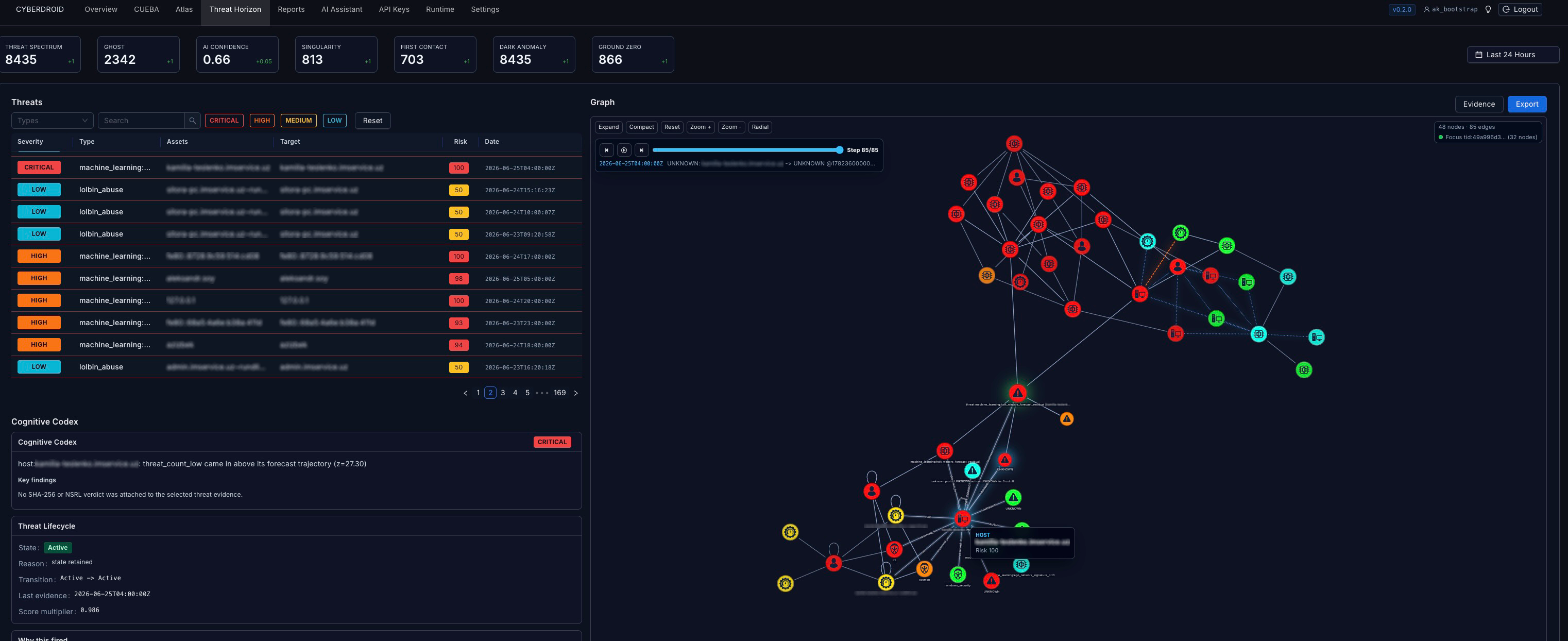
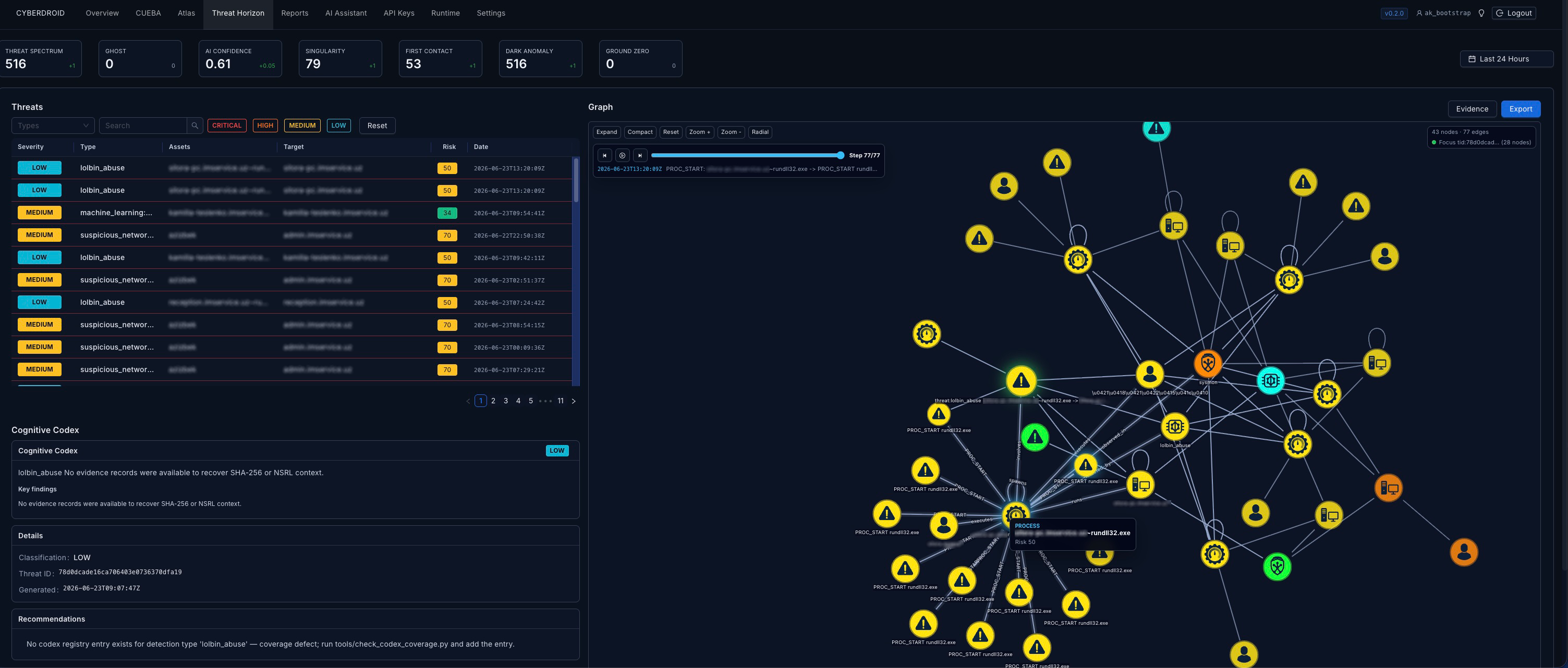
CNE-SHOT-TH-01 LIVE INVESTIGATION
Threat Horizon threat spectrum and campaign graph
The threat spectrum — severity-filtered queue, Cognitive Codex findings, threat lifecycle, and the campaign graph with step-through evidence playback.
CNE-SHOT-TH-02
Threat Horizon evidence timeline
Evidence playback — every step of the chain, replayable in order.
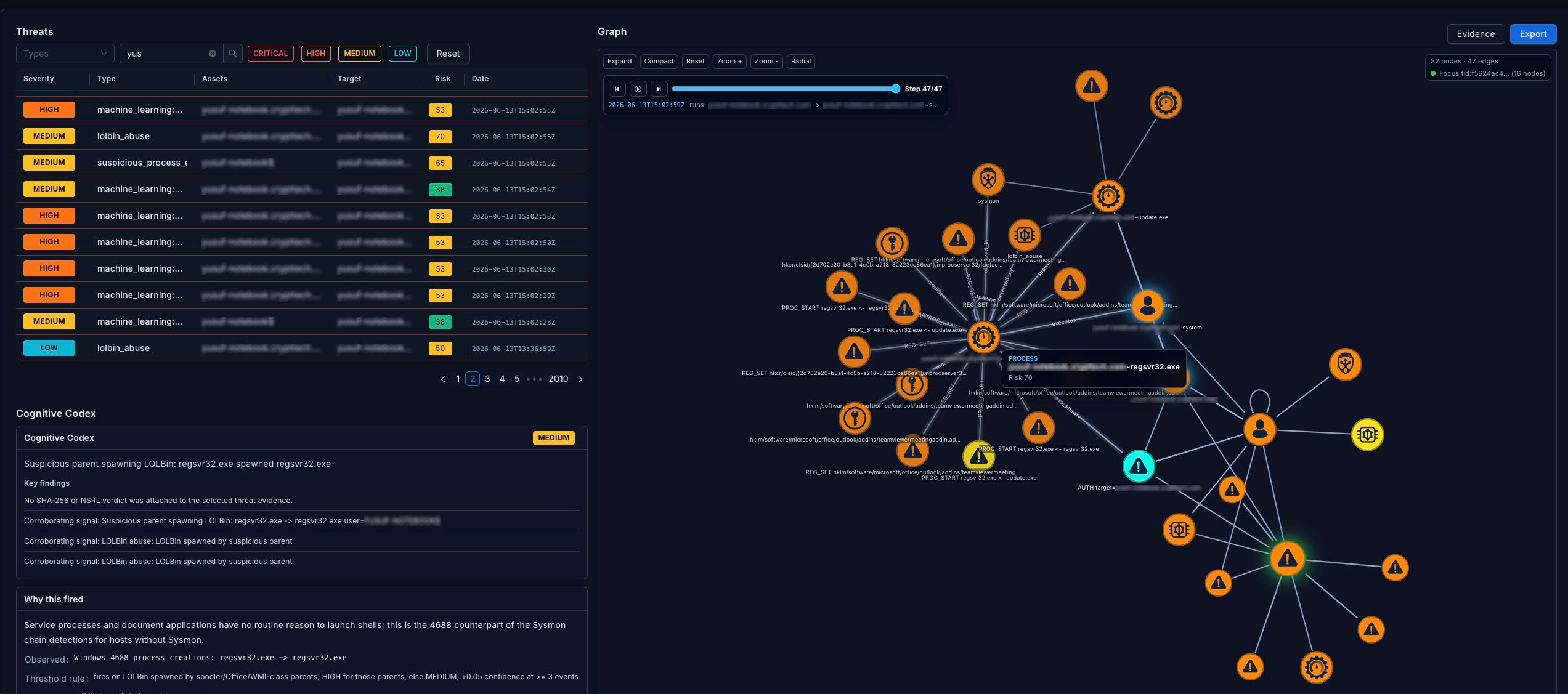
CNE-SHOT-TH-03
Selected-threat graph with why-this-fired panel
"Why this fired" — a LOLBin chain with corroborating signals and threshold rules, in plain language.
THE ALGORITHM LIBRARY

200+ instruments.
One evidence pipeline.

Every algorithm has a stable ID, a defined objective, required telemetry, and a documented evidence product — disclosed in a client-safe catalog. Procurement, audit, and detection engineering can all answer the same question: "which algorithms are you using?"

The library spans time-series baselines, change & drift, outlier & density, deep learning, sequence & language, graph, and fusion analytics — roughly 90 named algorithm families, with the 200+ figure counting variants and research-grid combinations under an explicit counting rule.

The full, named inventory ships in the client-safe catalog, and tier badges publish the Forward Flight Plan — production today, staged next, research beyond. Nobody has to guess.

The instruments nobody else has.

{{ p.id }} {{ p.badge }}
{{ p.name }}

{{ p.desc }}

Patented and patent-pending. Identifiers available in the Cyberdroid Patent/IP Schedule; algorithm details under NDA.

Where new combinations are born.

A dedicated research cluster trains, fuses, and validates new algorithm combinations against production-shaped telemetry before staged rollout — from detector fusion to graph neural scoring with explainability guardrails. Nothing ships until it survives contact with real operations: online computation, bounded memory, explainable evidence, and safe failure under drift.

THE FORWARD FLIGHT PLAN

The library is designed to grow with customers. Every new entry follows a public template — objective, telemetry, method, evidence product, operational notes — and co-development is part of the offer.

WHY CYBERDROID

Five reasons this engine is different.

{{ rn.n }}
{{ rn.title }}

{{ rn.body }}

WHAT WE WON'T CLAIM
No unverifiable benchmark wins. No "autonomous SOC." No black-box scores you have to take on faith.

Cyberdroid Neural Engine complements SIEM and XDR stacks by adding behavior, relationship, and campaign intelligence — and every claim on this site maps to an inspectable evidence surface.

TEN YEARS IN THE MAKING

A decade of hard work, science, and performance — condensed into one engine.

Cyberdroid Neural Engine was not assembled in a funding cycle. More than ten years of research and engineering stand behind it — the patented and patent-pending prediction, wavelet, and temporal-quantization families among them. Every instrument in the library earned its place.

REQUEST A TECHNICAL DEMO

See it on telemetry like yours.

Built for scrutiny — bring your detection engineers.

{{ d.n }}
{{ d.title }}
{{ d.desc }}
Want the technical detail first? Explore the algorithm library.

Bring your hardest detection question.

Use the shared briefing desk to tell us about your SIEM, telemetry, deployment constraints, and the scenario you want to inspect.

Request a Technical Demo
THE BRIEFING PAGE PREPARES AN EMAIL DRAFT · NOTHING IS SENT AUTOMATICALLY